Wellness studios - yoga, Pilates, barre, dance, and multi-discipline practices - need scheduling software built for group classes, not adapted from 1:1 appointment booking. The key features are recurring class templates, capacity management, waitlists, multiple pricing model support, and online self-booking. Choosing a platform designed for studios rather than health clinics makes a meaningful difference.
Wellness studios - yoga, Pilates, barre, dance, aerial, and any other group-based movement practice - have scheduling needs that are fundamentally different from 1:1 health practices. Yet much of the scheduling software on the market was built for health clinics and adapted for studios, or built for large gym chains and scaled down. Neither fits a boutique wellness studio particularly well.
This guide covers what studio owners should actually look for when evaluating class scheduling software - from the features that matter most to the questions that reveal whether a platform was built with studios in mind.
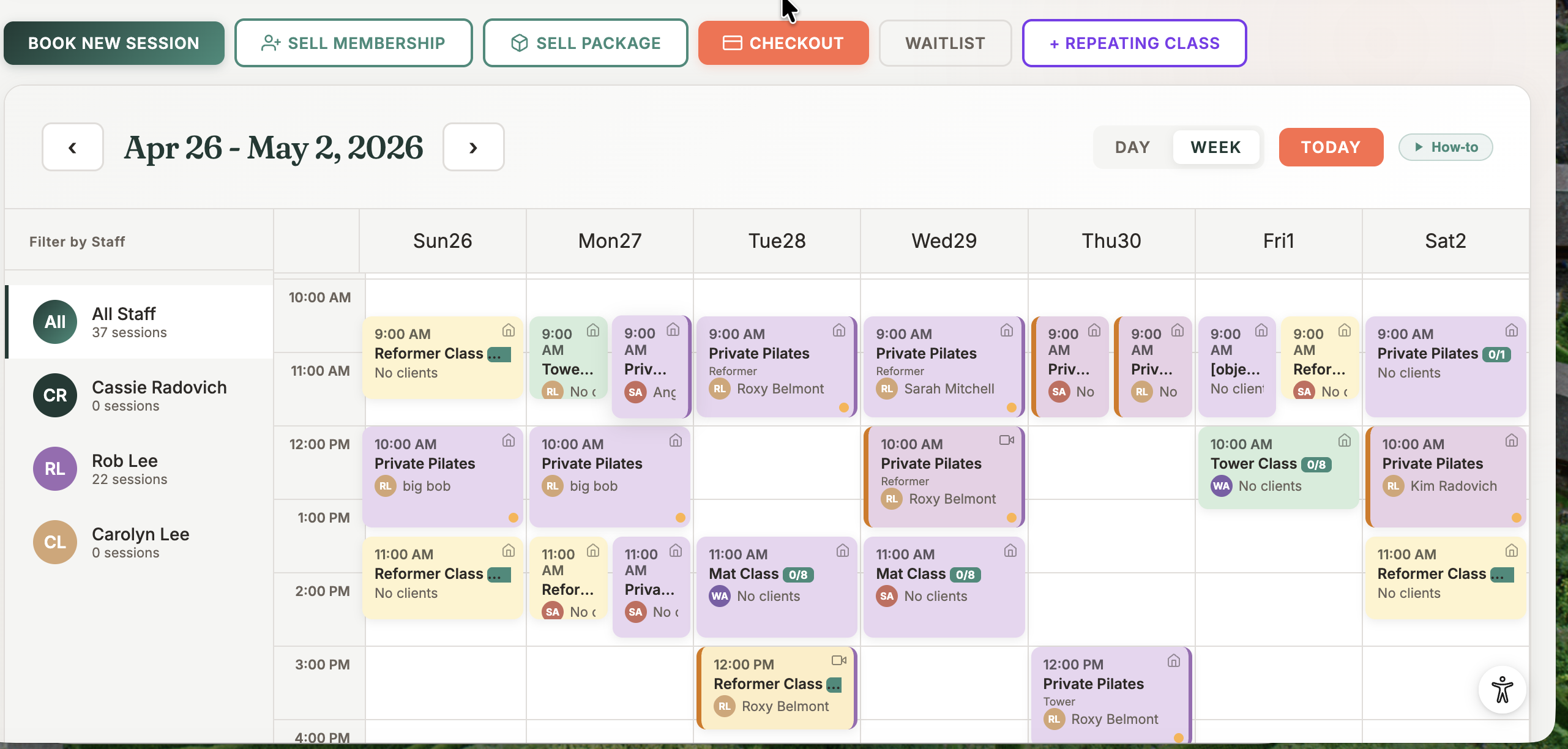
Why studio scheduling is different from clinic scheduling
In a health clinic, scheduling is primarily about individual appointments - one practitioner, one client, one time slot. The challenge is managing availability and minimizing gaps in the calendar.
In a wellness studio, scheduling is about managing group sessions with fixed capacities, multiple instructors, recurring weekly patterns, and clients who attend under different pricing structures simultaneously. The same 9am Tuesday yoga class runs every week, has twelve spots, is taught by one of three possible instructors depending on the week, and needs to accept bookings from both drop-in clients and members - all with their own rules about credits and cancellations.
Appointment scheduling software manages time slots and practitioners. Class scheduling software manages programmes, rooms, instructors, capacity, membership eligibility, and the client experience of browsing and booking a schedule. They are different problems.
Must-have features for wellness studios
- Recurring class templates - Create a weekly schedule once and have it repeat automatically, with the ability to modify individual occurrences for holidays, workshops, or instructor changes.
- Capacity management - Each class enforces a maximum number of spots. When a class is full, new bookings go to the waitlist automatically - clients are never shown a fully booked class with no path forward.
- Waitlist with auto-fill - When a cancellation occurs, the next waitlisted client is notified immediately and given a window to confirm. The class fills itself.
- Online self-booking - A public-facing schedule that clients can browse, filter by class type or instructor, and book directly - 24 hours a day, without calling the studio.
- Multiple pricing model support - Drop-in, class packs, and memberships must coexist in the same system, with automatic credit decrement and membership eligibility checking.
- Automated reminders - Email and SMS reminders before each class, with a one-click cancel link. Reminders that make cancelling easy keep classes full by filling spots from the waitlist.
- Digital waivers - Liability waivers collected and stored online before the first class.
Supporting multiple pricing models
Most wellness studios offer drop-in rates, class packs, and memberships simultaneously - and expect clients to be able to use any of them to book the same class. The scheduling software needs to handle this elegantly:
When a client books a class, the system should check their account: do they have an active membership? Remaining pack credits? Then decrement the appropriate balance and confirm the booking. If they have no credits or membership, they should be prompted to purchase before confirming.
The class pack experience particularly matters. Clients need to be able to see their remaining credits at any time. Packs should have expiry dates that are clearly visible and that the system enforces automatically. When a client's pack runs low, the system should ideally prompt them to purchase another - not simply fail on the next booking.
Pricing tip: Set your drop-in rate as your highest per-class price. When drop-in classes are cheap, packs and memberships lose their value proposition. The price gap - typically 20–35% savings for a pack versus drop-in equivalent - is what motivates clients to commit to a bundle.
The client booking experience
The quality of the client booking experience has a direct impact on how many people actually book - and how many come back. Clients who find booking confusing or cumbersome don't always complain; they just quietly book elsewhere.
The standard a wellness studio booking experience should meet in 2026:
- Mobile-first - the majority of clients will book on a phone
- Browsable schedule that filters by date, class type, and instructor
- Clear display of remaining spots (or waitlist count when full)
- Booking confirmed in three taps or fewer
- Immediate email confirmation with class details and cancel link
- Self-service cancellation - no phone calls required
Class scheduling built for Canadian wellness studios
MyoStudio - group classes, memberships,
and online booking in one platform.
See MyoStudio →
Instructor and staff tools
As a studio grows and adds instructors, the scheduling system needs to support more than just the owner's view. Instructors should be able to: see their own upcoming schedule, view the class roster before each session, and note attendance. They shouldn't have access to financial data or other instructors' private information unless that's appropriate for their role.
Sub management is a practical necessity: when an instructor can't teach, the studio needs to be able to assign a substitute and notify registered clients automatically. Systems that require manual client notification for substitutions add significant admin overhead at exactly the wrong moment - when the primary instructor has just called in sick at 7am.
What Canadian studios should check
Many popular wellness studio software platforms originate in the US or Australia and aren't designed for the Canadian context. A few things to verify before committing to a platform:
- Pricing currency - Is the platform priced in CAD? USD pricing adds 30–40% to the effective cost at current exchange rates.
- Payment processing - Does the platform support Canadian payment processing? Some US platforms have limited or slow Canadian payouts.
- Data hosting - If your studio offers any health-related services alongside group fitness, client health information may be subject to PHIPA. Confirm where client data is stored.
- GST/HST handling - Fitness services are generally taxable in Canada. Your invoicing software should handle GST/HST correctly for the services you offer.
Common questions
The best scheduling software for a small wellness studio handles recurring group classes, capacity limits, waitlists, drop-in and membership pricing, online self-booking, and automated reminders - all without requiring enterprise-level complexity. MyoMesh MyoStudio is built for exactly this, designed for Canadian Pilates, yoga, and multi-discipline studios.
Sometimes, but not always well. Health clinic software is built around 1:1 appointments, clinical documentation, and health billing. Wellness studios primarily need group class scheduling, capacity management, membership tracking, and class pack management. Platforms built specifically for studios handle these workflows more naturally. MyoMesh supports both - 1:1 sessions and group classes - which is useful for studios that combine movement classes with private health sessions.
Drop-in is a single class purchase at the highest per-class rate - flexible, no commitment. Memberships are recurring monthly plans (unlimited or capped at a number of classes) that create predictable revenue and stronger retention. Class packs sit in between - pre-purchased bundles at a discount from drop-in, with an expiry date. Most studios offer all three simultaneously, and your scheduling software needs to manage each cleanly.
Class scheduling built for
Canadian wellness studios.
MyoStudio includes group class scheduling, capacity management, waitlists, membership billing, and online booking - everything a wellness studio needs from day one.
See MyoStudio See it live - 20 min with Rob