Most wellness studios offer three pricing structures simultaneously: drop-in (highest per-class rate), class packs (discounted bundles), and memberships (recurring monthly, best for retention). The pricing relationship between these three determines how naturally clients move toward commitment. Drop-ins should always be your most expensive option per class - this is what makes packs and memberships feel like obvious value.
Pricing is one of the most consequential decisions a wellness studio makes - and one of the most frequently underpriced. Studio owners who have spent years developing a teaching practice often undervalue their time, their expertise, and the experience they create for clients. Pricing too low creates a business that's busy but not profitable, and attracts clients who leave the moment a cheaper option appears.
This guide covers the three pricing structures that most wellness studios offer, how to set prices that drive both revenue and retention, and the common mistakes that leave money on the table.
The three pricing models every studio needs
Wellness studios typically offer three pricing structures simultaneously. Each serves a different client segment and a different stage of the client relationship:
- Drop-in: Single class, highest per-class rate. Best for new clients exploring your studio, travelers, and clients with genuinely unpredictable schedules.
- Class packs: Pre-purchased bundle of classes (5, 10, 20) at a discounted per-class rate. Requires commitment upfront; best for clients who aren't ready for a monthly commitment but attend regularly enough to value a discount.
- Memberships: Recurring monthly payment for unlimited or capped classes. Creates predictable revenue and builds attendance habits. Best for your most committed clients and the model that drives the strongest retention.
A clean pricing structure has one drop-in rate, one or two pack options, and two or three membership tiers. More complexity than this - five different pack sizes, four membership tiers - creates decision paralysis and slows conversion. Simpler is almost always better.
Drop-in pricing: the anchor
Your drop-in rate is the most visible number in your pricing. It's what most first-time visitors will pay, and it serves as the anchor that makes your packs and memberships look like good value by comparison.
Canadian Pilates and yoga studios typically price drop-in classes at $22–35 for mat or general yoga, and $30–45 for reformer Pilates, depending on market and studio positioning. Rates in major urban centres like Toronto and Vancouver are at the upper end of these ranges; smaller cities and towns are typically lower.
One important principle: your drop-in rate should always be your highest per-class price. If your 10-class pack works out to $22 per class and your drop-in rate is $20, you've given clients no financial reason to commit to a pack. The drop-in premium - typically 25–40% more per class than your pack rate - is what makes the commitment feel financially intelligent.
Class packs: the middle tier
Class packs bridge the gap between the full flexibility of drop-in and the full commitment of membership. They're a good fit for clients who attend regularly enough to want a discount, but whose schedule or financial situation isn't right for a monthly commitment.
Practical considerations for class pack design:
Size options. Two pack sizes is usually enough - a smaller pack (5 classes) for newer clients and those with lighter attendance, and a larger pack (10 or 20 classes) for committed regulars who want the best per-class rate. More than two options creates unnecessary complexity.
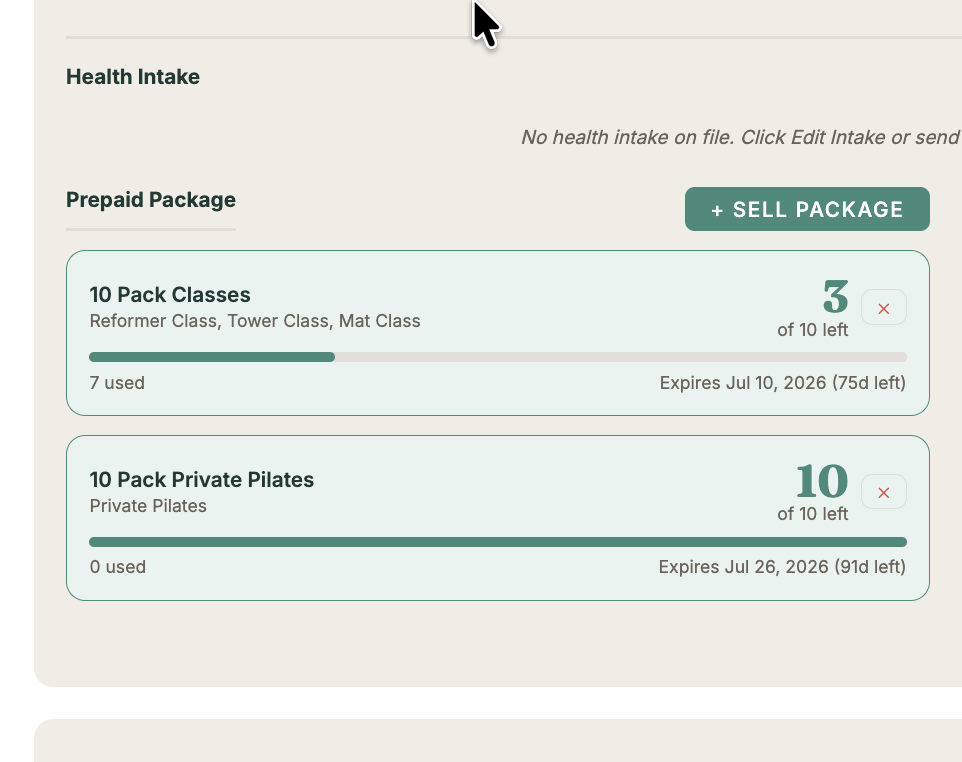
Expiry dates. Packs should expire - typically 3 months for a 5-class pack, 5–6 months for a 10-class pack. Expiry dates create urgency that drives attendance, protect you from unlimited open-ended liability, and prevent clients from buying a large pack and using it so slowly that it distorts your capacity planning. Communicate expiry dates clearly at the point of sale - clients who discover an expiry date after the fact feel deceived.
Per-class rate. Should be 20–30% below your drop-in rate for a smaller pack, and 30–40% below for a larger pack. This makes the value proposition obvious without eroding your revenue per session.
Memberships: the retention engine
Memberships are the most powerful pricing structure for wellness studios, for two reasons: they create predictable monthly revenue, and they build attendance habits that dramatically improve client retention.
A client on a $160/month membership has already committed to attending. The question is which class, not whether to go. A client on drop-ins answers that question fresh every week - and some weeks, the answer is no. Membership removes the repeated decision, which is what turns sporadic attendance into a consistent habit.
Monthly membership pricing for Canadian studios in 2026 typically ranges from $130–200 for mat-based yoga, and $160–280 for reformer Pilates, depending on class frequency and market. Reformer memberships are higher because class sizes are smaller and equipment costs are real.
Common membership structures that work well:
- 4 classes/month: Entry-level commitment, good for clients who want one class per week
- 8 classes/month: Mid-tier, works out to twice weekly attendance - the frequency associated with the strongest retention outcomes
- Unlimited: Best for frequent attendees; requires careful pricing to avoid margins being squeezed by heavy users
Capped memberships often outperform unlimited ones for new studios. Unlimited memberships can create crowding at peak times and margin pressure from heavy users. Capped plans (8 classes per month, for example) create more predictable capacity and better margins while still delivering the retention benefit of a monthly commitment.
Membership billing and class pack tracking built in
Set up your pricing once.
Let the software handle the rest.
See MyoStudio →
Getting the price relationships right
The relationship between your drop-in, pack, and membership prices determines how naturally clients move toward commitment. A good structure makes the progression feel financially obvious:
- Drop-in: $32/class
- 10-class pack: $220 ($22/class - 31% savings vs drop-in)
- 8-class membership: $160/month ($20/class - 37.5% savings vs drop-in)
- Unlimited membership: $200/month
At these prices, a client who attends more than seven classes in a month is better off on the unlimited membership than the 8-class plan. A client who attends more than five classes is better off on the membership than a class pack. The math does the selling for you.
Introductory offers: converting first-timers
Introductory offers serve one purpose: getting a new client to experience your studio more than once. A single drop-in visit doesn't build habit or community; three or four visits over two weeks starts to.
Common intro offer structures that work:
- Two-week unlimited pass at a fixed price ($49–79). High perceived value, creates multiple visits, and ends at a natural conversion moment.
- First class free or discounted. Low barrier to entry, but single-visit intro offers have lower conversion rates than multi-visit ones.
- 3-class intro pack at a significant discount ($39–49). Enough visits to experience the studio's full value before making a membership decision.
The intro offer should always end with an explicit invitation to continue: a conversation about membership, a limited-time offer to join at a reduced first-month rate, or at minimum, a clear path to the next pricing option. Let the offer expire silently and you've paid for a marketing cost with no conversion.
When and how to raise prices
Most studio owners wait too long to raise prices - and then raise them too much at once, creating client backlash that a series of smaller annual increases would have avoided. Small annual increases of 3–5% are easier for clients to accept than infrequent large jumps and keep your revenue in line with rising costs.
Give existing members advance notice - 30 days is standard - and frame increases around value, not cost: "We're investing in new equipment and instructor development, and we're making a small adjustment to our membership rates starting next month." This is almost always received better than a sudden invoice change with no communication.
Common questions
Canadian yoga studios typically charge $22–35 per drop-in mat class and $30–45 per drop-in reformer Pilates class, with higher rates in major urban centres like Toronto and Vancouver. Your drop-in rate should always be your highest per-class price - this is what makes your class packs and memberships feel like obvious value.
A class pack is a pre-purchased bundle of sessions (5, 10, or 20 classes) that the client uses at their own pace until the credits run out or expire. A membership is a recurring monthly payment that gives the client ongoing access - either unlimited classes or a set number per month. Memberships create more predictable revenue and stronger retention; class packs serve clients who want flexibility without a monthly commitment.
Studio management software handles recurring membership billing automatically - charging each member's card on their monthly billing date, tracking payment failures, and updating membership status. This is one of the most important administrative functions your software should handle without manual intervention. Look for software that sends automated pre-billing notifications to members and handles failed payments with retry logic.
Membership billing and class pack tracking
handled automatically.
MyoStudio manages your drop-in rates, class packs, and membership billing in one platform - so you can focus on teaching, not spreadsheets.
See MyoStudio See it live - 20 min with Rob